
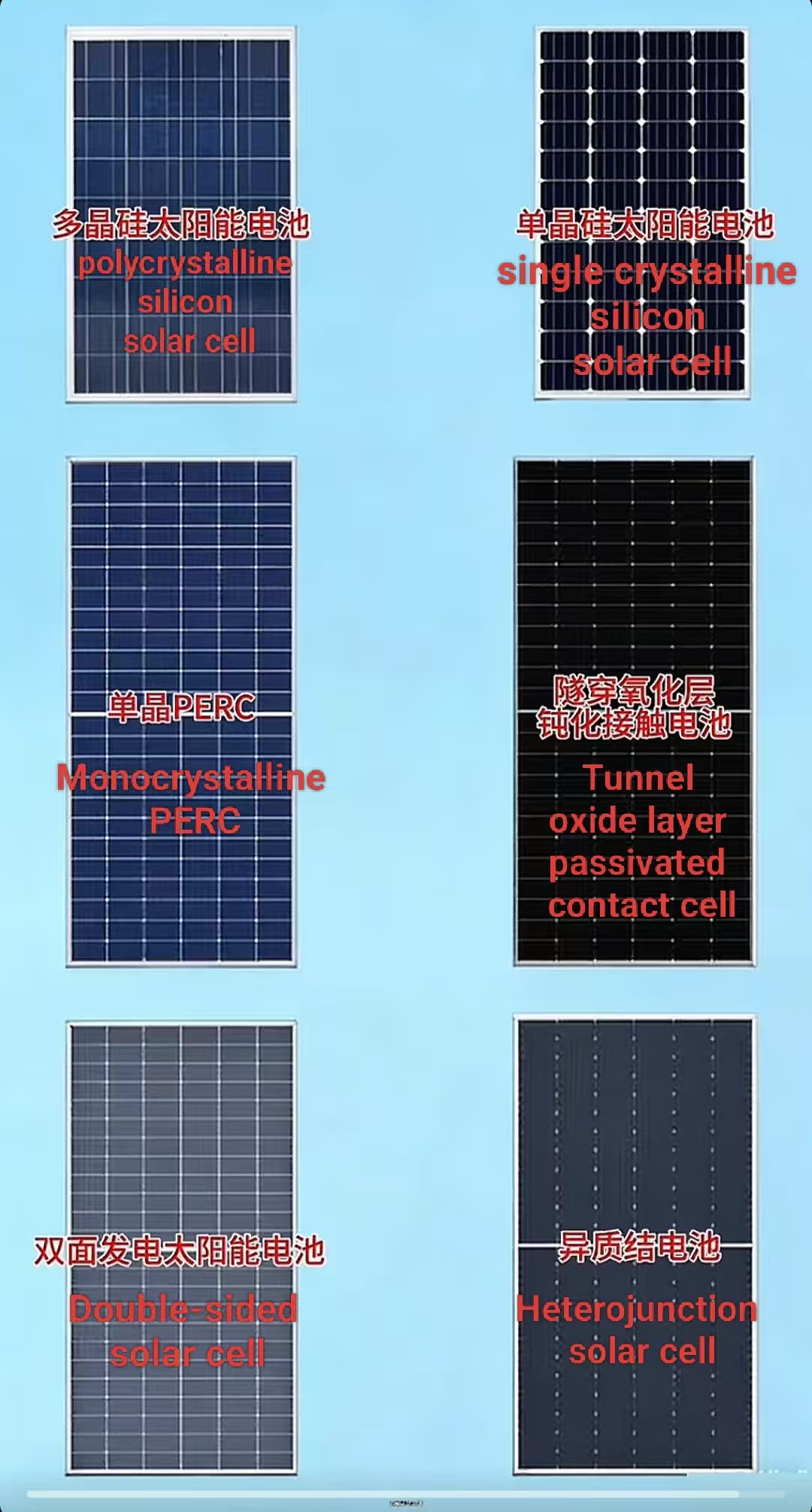
Under the guidance of the “Dual Carbon” goals, the photovoltaic industry has entered a deep-water zone for efficient and large-scale development. As the core component of solar power systems, photovoltaic cells are undergoing rapid technological iteration. From the popularization of traditional P-type PERC cells to the full rise of N-type cells, three major mainstream high-efficiency technology routes—TOPCon (Tunnel Oxide Passivated Contact), HJT (Heterojunction), and IBC (Interdigitated Back Contact)—are competing on the same stage, becoming the core driving force for reducing the levelized cost of electricity (LCOE) and improving power generation efficiency in the photovoltaic sector. This article comprehensively dissects the core technical characteristics, advantages, and disadvantages of these three cell types, and combines the current industry landscape and technological trends to explore their future development prospects, providing a reference for industry practitioners, investors, and enthusiasts.
1. Core Technical Analysis of the Three High-Efficiency Cells
The core competitiveness of photovoltaic cells lies in three dimensions: conversion efficiency, manufacturing costs, and stability. Although TOPCon, HJT, and IBC all belong to the N-type high-efficiency cell camp (compared with P-type PERC cells, they have higher efficiency potential and lower attenuation rate), their technical principles and process routes differ significantly, which determine their respective application scenarios and development paths.
(1) TOPCon Cell: The “Transitional King” in PERC Iterative Upgrade
Proposed by the Fraunhofer Institute in Germany in 2013, the core logic of TOPCon technology is to form a passivated contact structure by fabricating an ultra-thin tunnel oxide layer and a highly doped polysilicon film on the surface of P-type or N-type silicon wafers, reducing carrier recombination and thus improving photoelectric conversion efficiency. Its biggest advantage lies in its strong compatibility with traditional PERC cell processes; it can be mass-produced through the upgrading and transformation of existing PERC production lines without the need for large-scale new line construction. It is currently the most cost-effective high-efficiency technology route. As of 2025, the share of TOPCon technology has jumped from around 2% in 2021 to 87.6%, making it the absolute mainstream of N-type cells.
(2) HJT Cell: A “Potential Stock” with Both High Efficiency and Low Carbon
First proposed by the University of Marburg in Germany in 1974, HJT (Heterojunction) cells adopt an “amorphous/crystalline silicon heterojunction” structure. Through the interface characteristics of different semiconductor materials, it achieves efficient passivation and carrier transport. Its process route is independent of PERC and TOPCon, requiring only four steps: texturing and cleaning, amorphous silicon thin film deposition, TCO thin film deposition, and electrode metallization. The process is simpler, and it has the advantages of low energy consumption and low carbon emissions, which are in line with the green development needs of the new energy industry. After Panasonic acquired Sanyo in 2010, HJT patents expired, and domestic and foreign manufacturers have started the industrialization process. At present, the laboratory efficiency has exceeded 26%, and the theoretical efficiency limit is 28.5%.
(3) IBC Cell: The “Good-Looking and Powerful” Leader in High-End Scenarios
Proposed by SunPower, IBC (Interdigitated Back Contact) cells have a history of nearly 40 years. Their core feature is that the emitter, back surface field, and positive and negative metal electrodes are all integrated on the back of the cell, with no metal grid lines on the front, which maximizes the utilization of incident light and reduces optical loss. Essentially, it is a “platform technology” that can be combined with TOPCon, HJT, perovskite, and other technologies to form higher-efficiency cell structures such as TBC and HBC. The theoretical efficiency limit is as high as 29.1%, making it one of the photovoltaic cell technologies with the highest efficiency potential. At the same time, due to the absence of grid lines on the front, it has an attractive appearance and is more suitable for high-end distributed scenarios such as household and BIPV.
2. Comprehensive Comparative Analysis of Advantages and Disadvantages of TOPCon, HJT, and IBC Cells
The three technical routes each have their own strengths, and there is no absolute “optimal solution”. Their differences are mainly reflected in conversion efficiency, manufacturing costs, process difficulty, stability, and application scenarios. The specific comparison is as follows:
(1) Conversion Efficiency: IBC > HJT > TOPCon (at the Laboratory Level)
In terms of laboratory efficiency, IBC cells take the lead with a theoretical limit efficiency of 29.1%, and the mass production efficiency of enterprises such as SunPower can exceed 25%; the theoretical limit efficiency of HJT cells is 28.5%, and the laboratory efficiency of domestic enterprises such as LONGi Green Energy has exceeded 26.3%, with the mass production efficiency generally between 24% and 25%; the theoretical limit efficiency of TOPCon cells is 28.7%, and the mass production efficiency is concentrated between 23% and 24%, with some leading enterprises able to break through 25%. However, in terms to the stability of mass production efficiency, TOPCon cells have smaller efficiency fluctuations due to mature processes, while HJT and IBC still have room for improvement in the consistency of mass production efficiency due to process complexity.
It is worth noting that during the “14th Five-Year Plan” period, the laboratory efficiency of photovoltaic cells in China has continued to break through. 27 research units from 11 institutions have broken the NREL laboratory efficiency records, accounting for 55% of the global total. In 2025 alone, 6 institutions broke the record 9 times, providing a solid foundation for the mass production of the three high-efficiency cell technologies.
(2) Manufacturing Costs: TOPCon < HJT < IBC (Current Mass Production Stage)
Cost differences mainly stem from process routes and equipment investment:
- TOPCon cells: Can be mass-produced through PERC production line upgrades, with a single GW renovation cost of only 0.6-0.8 billion yuan, no need for large-scale new equipment investment, and silver paste consumption has decreased by more than 35% compared with the early stage. It has significant cost advantages, and the current cost per watt is only 0.04-0.05 yuan higher than that of PERC.
- HJT cells: Require the construction of dedicated new production lines, with equipment investment cost more than twice that of PERC, and rely on low-temperature silver paste. Although the cost of low-temperature silver paste has dropped from 0.17 yuan/W in 2019 to 0.06 yuan/W in 2025, the overall cost per watt is about 0.15 yuan higher than that of TOPCon. Cost pressure is the core factor restricting its large-scale development.
- IBC cells: The process is the most complex, involving many similar semiconductor processes, with extremely high requirements for production equipment and technical thresholds. At present, only a few enterprises have mastered mature mass production technology, with the highest cost per watt. However, if the process is fully mastered, the cost can be level with that of PERC, with considerable long-term cost reduction potential.
(3) Process Difficulty: IBC > HJT > TOPCon
- TOPCon cells: Based on PERC upgrades, only about 3 new processes such as tunnel oxide layer preparation and polysilicon deposition are added. The process has high maturity, and the yield rate can reach more than 98%, making it suitable for large-scale mass production.
- HJT cells: Although there are only 4 processes, the requirements for thin film deposition accuracy and electrode metallization process are extremely high, with the yield rate generally between 95%-97%, and the localization rate of equipment still needs to be improved.
- IBC cells: It is necessary to solve technical problems such as the cross arrangement of back electrodes and the uniformity of the passivation layer. The process complexity is much higher than the first two, the yield rate is difficult to improve, and the mass production difficulty is the greatest. At present, only a few leading enterprises have achieved large-scale production.
(4) Stability and Attenuation Rate: HJT > IBC > TOPCon
The attenuation rate of N-type cells is generally lower than that of P-type PERC cells (the annual attenuation rate of PERC cells is about 0.5%-0.8%):
- HJT cells: Adopt a heterojunction structure, with no obvious light-induced degradation and potential-induced degradation, and the annual attenuation rate can be controlled below 0.3%, with the best stability.
- IBC cells: Due to the absence of grid lines on the front, the attenuation caused by electrode contact is reduced, with an annual attenuation rate of about 0.3%-0.4%.
- TOPCon cells: Although the attenuation rate is lower than that of PERC, affected by the doping uniformity of the polysilicon film, the annual attenuation rate is about 0.4%-0.5%, slightly higher than that of HJT and IBC.
(5) Application Scenarios: Each with Its Own Focus and Complementary Development
- TOPCon cells: With outstanding cost performance and mature processes, they are suitable for large-scale application scenarios such as centralized photovoltaic power stations and ordinary distributed photovoltaic power generation. They are the mainstream choice for high-efficiency photovoltaic projects at present, especially suitable for enterprises with stock PERC production lines to layout.
- HJT cells: With high efficiency, strong stability, low carbon and environmental protection, and the double-sided power generation characteristic is suitable for snow-covered areas, roof distributed and other scenarios. At the same time, it is suitable for stacking with perovskite cells (efficiency can exceed 29%), has great potential in high-end distributed and large-scale photovoltaic power stations in the future, and is more popular among new players without old production line baggage.
- IBC cells: With high efficiency and attractive appearance, and can be combined with other technologies, they are suitable for high-efficiency scenarios such as BIPV (Building Integrated Photovoltaic), high-end household photovoltaic, and portable photovoltaic products. It is difficult to popularize on a large scale in the short term, and will become the core choice of the high-end market in the long term.
3. Development Prospects of the Three High-Efficiency Cell Technologies
(1) TOPCon: Will Remain the Mainstream in the Short Term, with Gradual Gradual Shift in the Long Term
In the short term (3-5 years), TOPCon will still be the dominant technology in the N-type cell market. Driven by the demand for production line upgrades of existing PERC manufacturers, its market share will remain high. However, with the continuous reduction of HJT production line costs and the improvement of process maturity, the cost gap between HJT and TOPCon will narrow. In the long term, as large-scale new production lines are put into production, HJT is expected to erode TOPCon’s market share and become the new mainstream technology.
(2) HJT: Will Become the Core High-Efficiency Route with the Reduction of Costs
With the localization of HJT core equipment (such as PECVD, PVD, etc.) and the mass production of low-cost silver paste, the cost per watt of HJT cells is expected to drop to the level close to that of TOPCon by 2027-2028. At that time, its advantages in high efficiency, low attenuation and low carbon will be fully released, and it will become the core high-efficiency route in the photovoltaic industry, especially in the high-end distributed market and large-scale power station projects with high requirements for power generation efficiency.
(3) IBC: Will Focus on High-End Market Segmentation, with Synergistic Development with Other Technologies
IBC cells will focus on high-end market segments such as BIPV and high-end household photovoltaic in the short term, relying on their unique appearance and high efficiency. In the long term, with the breakthrough of process technology and the reduction of costs, it will form a synergistic development with HJT and perovskite cells. For example, HJT-IBC combined technology (HBC) is expected to break through the efficiency limit of 30%, becoming the next generation of high-efficiency cell technology leading the industry development.
In conclusion, the iterative development of high-efficiency photovoltaic cells is a process of competition and integration. TOPCon, HJT, and IBC will coexist and develop complementarily in a certain period of time. With the continuous progress of technology and the reduction of costs, the photovoltaic industry will eventually form a pattern dominated by a few high-efficiency technologies, which will further promote the global energy transition and contribute to the achievement of the “Dual Carbon” goals.